
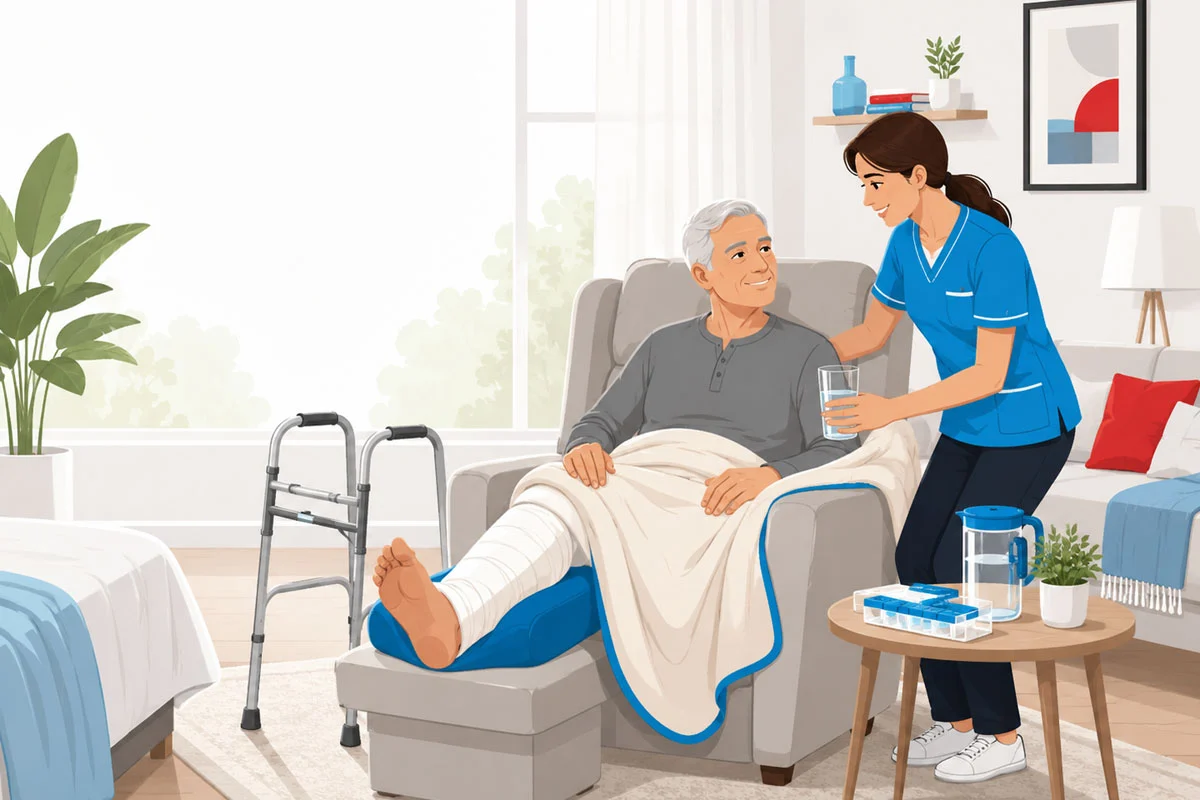
A caregiver supports a senior’s safe recovery at home after surgery with hydration, medication reminders, and daily assistance.
Table of contents
Show moreShow lessComing home from the hospital is often described as the finish line, but for an older adult, it is usually the beginning of the most demanding part of recovery. Nurses are no longer checking vital signs throughout the day, meals do not arrive automatically, and getting from the bed to the bathroom may suddenly feel like crossing an obstacle course. That is where in-home care after surgery for seniors becomes valuable. A dependable caregiver can provide hands-on assistance, monitor everyday changes, support the discharge plan, and help the senior recover without placing the entire responsibility on one exhausted family member. The goal is not to take control away from the older adult; it is to provide enough support for the senior to recover safely while preserving dignity and independence.
Every recovery is different. A senior returning home after cataract surgery may need transportation, meal preparation, medication reminders, and brief supervision, while someone recovering from a hip replacement, abdominal procedure, or heart surgery may require extensive mobility assistance and help throughout the day. Age alone does not determine the level of care. Strength before surgery, chronic health conditions, memory, balance, home layout, procedure type, and the availability of family support all shape the plan. This guide provides general educational information and should always be used alongside the surgeon’s discharge instructions, medication orders, therapy recommendations, and emergency guidance. MedlinePlus advises families to develop a discharge plan covering personal care, household assistance, medications, equipment, appointments, and emergency contacts before the patient leaves the hospital.
Why Recovery at Home Needs a Plan
A senior may look stable while sitting in a hospital bed, yet struggle once faced with stairs, a low toilet, an empty refrigerator, or a complicated medication schedule. Hospitals are carefully controlled environments, while homes contain pets, loose rugs, narrow walkways, poor lighting, and everyday responsibilities that do not pause simply because someone had surgery. A written recovery plan connects the medical instructions with real life, helping families understand how to implement care at home effectively. It answers practical questions such as who will prepare breakfast, who will help the senior shower, how prescriptions will be collected, and what happens when a caregiver is unavailable. Without those answers, small gaps can quickly become serious problems.
The hospital discharge planner, nurse, surgeon, patient, and family should begin this conversation before discharge, ideally before a planned procedure. MedlinePlus explains that a discharge plan can help a patient receive appropriate care after leaving the hospital and may help prevent an avoidable return. Early planning ensures all necessary details are addressed, reducing the risk of complications or readmission. The plan should identify new medications, discontinued medications, dressing instructions, activity restrictions, medical equipment, scheduled appointments, emergency contacts, and the type of assistance required at home.
Think of the recovery plan as a bridge between the operating room and normal life. A bridge with missing boards may appear usable until someone places weight on it. In the same way, a vague promise that “the family will help” is not enough unless the family decides who will be present, when they will arrive, and which responsibilities they can safely handle. Strong planning does not guarantee that recovery will be effortless, but it reduces uncertainty and allows the senior, family, caregivers, and clinicians to work from the same map.

Post-hospital home care can improve recovery outcomes by providing personalized support, medication help, and daily assistance at home.
What In-Home Post-Surgical Care Includes
Post-surgical home care can include a combination of personal assistance, household support, supervision, transportation, companionship, and coordination with medical professionals. The exact services depend on the senior’s discharge orders and functional abilities. A non-medical caregiver may help with bathing, dressing, grooming, toileting, safe transfers, walking, meals, laundry, light housekeeping, transportation to appointments, and medication reminders. The caregiver can also observe changes in appetite, alertness, mobility, mood, and general condition, then report concerns to the family or appropriate healthcare provider. The caregiver should not independently diagnose complications, alter medications, perform skilled medical procedures outside their authorized role, or override the surgeon’s directions.
Skilled services may also be ordered when the senior needs nursing care, wound treatment, injections, physical therapy, occupational therapy, speech-language therapy, or medical monitoring. Medicare describes covered home health services as medically necessary, part-time or intermittent care provided under an authorized plan by a Medicare-certified home health agency. Covered services may include surgical wound care, therapy, patient education, certain medical supplies, and limited home health aide assistance when the patient is also receiving qualifying skilled services.
Families often benefit from using both forms of support. A nurse may visit for wound care and clinical assessment, while a non-medical caregiver remains longer to prepare meals, help the senior move safely, provide reminders, and prevent overexertion. One service does not automatically replace the other. The best arrangement fills the actual gaps between professional medical visits.
Personal Care and Mobility Support
Activities that once required little thought can become physically demanding after surgery. A trained caregiver can assist with activities of daily living while encouraging the senior to do as much as can be completed safely, fostering confidence and reassurance. This balance is important because doing everything for the senior can weaken independence, while too little help may increase risks. The caregiver should follow the surgeon’s weight-bearing restrictions, transfer instructions, and therapy plan rather than improvising movements.
Mobility support may include helping the senior sit up, transfer from bed to chair, use a walker correctly, reach the bathroom, reposition for comfort, and complete prescribed walking or therapy activities. The caregiver should keep frequently used items within reach and make sure glasses, hearing aids, mobility devices, and supportive footwear are available before the senior stands. MedlinePlus recommends preparing appropriate equipment, such as a shower chair, walker, reacher, raised toilet seat, and secure bathroom grab bars, when needed. It also warns that towel racks should not be treated as grab bars because they may not support a person’s weight.
Good assistance should feel like a steady handrail, not a cage. The caregiver stays close enough to prevent avoidable harm while allowing the senior to participate in recovery. Progress may look small from day to day, but safely walking a few more steps, completing part of a dressing routine, or transferring with less assistance can represent meaningful improvement.
Medication, Meals, and Hydration
Medication routines frequently change after surgery. A senior may return home with pain medication, antibiotics, blood-thinning medication, stool softeners, or temporary instructions affecting medicines used before the procedure. Confusion can arise when old prescription bottles remain in the home, brand and generic names look different, or multiple family members assume someone else administered the dose. The discharge plan should clearly identify what to start, what to continue, what to stop, when each medicine should be taken, and which side effects require a call to the healthcare provider. MedlinePlus specifically recommends maintaining a complete medication list and highlighting medicines that are new, changed, or discontinued.
A non-medical caregiver can provide reminders, read the approved schedule, record when reminders were given, and notify the family when a medication appears to have been missed. Medication administration rules vary by caregiver credentials, agency policy, care setting, and state law, so families should ask exactly what assistance is permitted. A caregiver should never decide to double a missed dose, stop a medicine, change the timing, or give an over-the-counter product without approval from the appropriate clinician or pharmacist.
Meals and hydration deserve equal attention. Pain, nausea, constipation, fatigue, medications, reduced mobility, and changes in taste can lower appetite. Older adults may also experience a reduced sense of thirst, which can make dehydration less obvious. MedlinePlus advises older adults to consume adequate fluids when permitted and notes that some older people need additional protein. However, the surgeon or dietitian may set specific restrictions for conditions involving the heart, kidneys, swallowing, blood sugar, or digestive system. A caregiver can prepare approved meals, offer manageable portions, keep drinks accessible, and track concerning changes without inventing a medical diet.
Transportation and Follow-Up Coordination
Recovery does not remain inside the home. Seniors may need follow-up appointments with the surgeon, primary care provider, therapist, wound clinic, cardiologist, or another specialist, sometimes within days of discharge. Getting there can be complicated when the senior cannot drive, has difficulty entering a vehicle, needs a walker, or is taking medication that affects alertness. A reliable transportation plan should include more than a car and driver. The family must consider whether the senior needs physical assistance from the front door to the vehicle, help entering the medical office, support during the appointment, and someone who can listen to instructions.
An in-home caregiver may help organize appointment dates, prepare necessary documents, confirm transportation, gather mobility equipment, and accompany the senior when the service is included in the care plan. The caregiver or family member can bring the updated medication list, discharge paperwork, symptom notes, and questions that arose at home. This is especially helpful when the senior feels tired, anxious, or overwhelmed by medical information. MedlinePlus recommends that the discharge plan list appointment dates, provider names, phone numbers, medication instructions, dressing directions, and the person to contact when questions or problems arise.
Follow-up appointments are not administrative chores. They allow the clinical team to assess healing, review pain, evaluate mobility, inspect the surgical area, adjust treatment, and determine whether restrictions should continue. Missing an appointment can leave the recovery plan running on outdated information. A caregiver helps keep the process connected, like a thread running from the hospital to the home and back to the medical team.
The First 72 Hours After Hospital Discharge
The first three days at home can expose problems that were difficult to see in the hospital. Anesthesia effects may not have completely faded, pain medication may cause drowsiness or constipation, sleep may be disrupted, and the senior may discover that ordinary household movements are harder than expected. Someone responsible should review the discharge instructions as soon as the senior arrives home rather than waiting for a problem. Prescriptions should be available, the first doses should be understood, the sleeping area should be ready, the route to the bathroom should be clear, and emergency contact numbers should be easy to locate. The senior should not be left alone when the discharge team has recommended supervision.
During this period, the caregiver should observe the senior’s general condition without turning the home into a hospital ward. Is the senior alert and communicating normally? Can the person eat, drink, use the bathroom, and move according to the prescribed restrictions? Is pain controlled according to the plan, or is it becoming unexpectedly severe? Is the surgical dressing remaining as instructed? Any tracking should follow the surgeon’s directions because procedures differ, and a normal symptom after one operation may require attention after another.
The first 72 hours are also when a practical communication system becomes essential. Decide who contacts the surgeon, who updates relatives, and where medication and symptom information will be recorded. Avoid having several family members independently call the medical office with conflicting information. CDC guidance identifies increasing redness or pain around the surgical area, cloudy drainage, and fever as possible signs of a surgical site infection and advises contacting the healthcare provider when infection symptoms appear. When the home plan is organized from the first evening, everyone can respond faster and with greater confidence.
Common Risks During Senior Recovery
Older adults can recover successfully at home, but surgery may temporarily magnify existing vulnerabilities. Reduced strength, pain, unfamiliar medication, dehydration, poor sleep, vision problems, hearing loss, memory changes, and movement restrictions can interact with one another. A senior who is mildly unsteady under normal circumstances may become significantly less stable after several nights of poor sleep and a new pain medicine. A person who usually manages prescriptions independently may make errors when doses have changed or when postoperative fatigue affects concentration. These risks do not mean that home is automatically unsafe. They mean the home plan must match the senior’s condition rather than relying on assumptions.
Families should pay attention to changes from the senior’s usual baseline. Sudden confusion, unusual sleepiness, agitation, inability to complete previously manageable tasks, declining food or fluid intake, worsening balance, or increasing dependence can signal a need for medical guidance or additional support. The National Institute on Aging’s SAGES research summary states that “Older adults commonly develop delirium after major surgical procedures.” Delirium involves an acute change in attention and awareness and may present as agitation, but it can also appear as quiet withdrawal or unusual drowsiness.
The caregiver’s role is not to label the cause of a change. It is to recognize that something is different, document what occurred, and follow the escalation instructions provided by the healthcare team. Early communication is often more useful than waiting until several concerns accumulate.
Falls, Medication Errors, Infection, and Confusion
Falls deserve special attention because postoperative seniors may be weaker, slower, or more affected by medication than they realize. The CDC reported in February 2026 that one in four older adults falls each year, representing more than 14 million people. About 37% of older adults who report a fall also report an injury that required medical treatment or restricted activity for at least a day. The age-adjusted fall death rate among older adults increased 21% between 2018 and 2024, underscoring why safe transfers, clear walkways, appropriate mobility devices, lighting, and supervision matter.
Medication errors can occur when the postoperative schedule is layered on top of existing prescriptions. A written list, one designated medication organizer, and one consistent record are safer than relying on memory or scattered notes. Questions about missed doses, side effects, interactions, or duplicate medicines should be directed to the surgeon, prescribing clinician, or pharmacist. New confusion should never be dismissed as “just age,” especially when it appears suddenly after surgery.
Infection monitoring should follow the procedure-specific instructions. The CDC lists redness and pain around the surgical area, cloudy wound drainage, and fever among potential signs of a surgical site infection. Hands should be cleaned before and after approved wound care, and family members should not touch the surgical wound or dressing unnecessarily. A caregiver can observe, remind, and report, but skilled wound treatment should be performed only by the senior, an instructed family caregiver, or an appropriately licensed professional according to the clinical plan.
How to Choose the Right Level of Care
The right amount of care is based on needs, not on a generic package. Start by asking what the senior can safely do alone, what can be completed with occasional assistance, and what requires direct supervision or hands-on support. Consider mobility, toileting, bathing, dressing, meal preparation, medication routines, memory, nighttime needs, transportation, and relatives’ caregiver availability. Then consider how quickly those needs could change. Someone who needs four hours of help on the first day may improve quickly, while another senior may need increasing support after fatigue, pain, or a complication becomes apparent.
The surgeon, hospital discharge planner, therapist, nurse, and primary care provider can help determine whether home is appropriate and whether skilled services are needed. Some patients may be safer in a rehabilitation or skilled nursing facility before returning home. MedlinePlus recommends discussing discharge arrangements in advance for elective surgery and consulting the hospital’s discharge coordination team when the hospitalization was unexpected.
When home is appropriate, coverage can range from short caregiver visits to around-the-clock assistance. Morning and evening support may be enough when the senior mainly needs help bathing, dressing, preparing food, and settling for the night. Longer shifts may be appropriate when the person cannot transfer safely, lives alone, becomes confused, or requires frequent supervision. Overnight care may be necessary when bathroom trips, wandering, pain, or fall risk continue after bedtime. The plan should be reassessed as recovery progresses instead of continuing unchanged out of habit.
Family Help, Non-Medical Home Care, and Home Health
Families often use the terms home care and home health care interchangeably, but they describe different forms of support. Non-medical home care focuses on everyday safety, personal assistance, household activities, companionship, and routines. Home health care is clinical care ordered by an authorized provider and delivered through qualified professionals, such as nurses and therapists. Family help can be an important part of either plan, but relatives should be realistic about work schedules, physical ability, medical knowledge, sleep, and caregiver stress.
| Type of support | Typical services | Best suited for | Common limitations |
|---|---|---|---|
| Family assistance | Meals, transportation, check-ins, errands, companionship, basic personal help | Seniors with reliable relatives and limited care needs | Availability, fatigue, physical limitations, and inconsistent schedules |
| Non-medical home care | Bathing, dressing, toileting, mobility assistance, meal preparation, light housekeeping, reminders, supervision | Seniors who need regular help with daily life and safety | Does not replace skilled nursing, therapy, or medical diagnosis |
| Medicare-certified home health | Skilled nursing, wound care, physical therapy, occupational therapy, speech therapy, limited qualifying aide care | Eligible homebound patients who need intermittent skilled services | Usually intermittent and does not provide continuous custodial care |
| Skilled nursing or rehabilitation facility | Nursing oversight, rehabilitation, meals, personal care, and structured supervision | Patients who cannot yet recover safely at home | Requires temporary placement outside the home and eligibility or payment arrangements |
Medicare currently covers qualifying part-time or intermittent skilled home health services for eligible homebound patients under an authorized care plan. It generally does not cover 24-hour home care, meal delivery, unrelated homemaker services, or personal care when personal assistance is the only service needed. Many families therefore combine skilled visits with privately paid home care, long-term care insurance benefits, Medicaid programs when eligible, community services, or scheduled family assistance. The best option is rarely the one with the most impressive label. It is the one that consistently covers the senior’s real needs.
Questions to Ask Before Hiring a Home Care Provider
Choosing a home care provider should involve more than asking whether someone is available tomorrow. Begin with the agency’s screening, training, supervision, insurance, communication practices, and experience supporting seniors after surgery. Ask whether the caregiver can assist with the specific mobility device, transfer method, bathing routine, and personal care needs listed in the discharge plan. Confirm which tasks are allowed, particularly around medications, wound-related observation, transportation, and communication with family members. A clear answer is a good sign; vague promises that a caregiver can “handle everything” should raise concerns.
Families should also ask how the agency handles schedule changes, caregiver illness, emergencies, and mismatches between the caregiver and client. Will a replacement be available? Who supervises the caregiver? How are concerns documented and reported? Can the plan be increased or reduced as the senior’s condition changes? Is overnight or weekend support available? These operational details may seem unimportant during the first phone call, but they determine whether the service remains dependable when recovery becomes unpredictable.
When skilled home health is prescribed, the agency must meet additional requirements. Medicare states that qualifying care must be ordered by an authorized healthcare provider, delivered through a Medicare-certified home health agency, and based on a regularly reviewed care plan. Medicare’s Care Compare service can also be used to locate and compare certified providers. Families should verify insurance benefits directly because Medicare Advantage plans, Medicaid programs, long-term care policies, veterans’ benefits, and private plans may follow different rules. The least expensive hourly rate is not always the least expensive outcome if missed shifts or poor coordination lead to a crisis.
Preparing the Home Before Surgery
Preparing the home in advance is one of the simplest ways to reduce avoidable stress. Walk through the home as though you were using a walker, moving slowly, and unable to bend or twist. Remove loose rugs, cords, clutter, unstable furniture, and objects that narrow the route between the bedroom, bathroom, kitchen, and main sitting area. Improve lighting, especially along nighttime routes, and make sure switches or lamps can be reached without walking through darkness. Keep a working phone or emergency alert device within reach rather than leaving it on the opposite side of the room.
The bathroom often requires the greatest attention because wet surfaces, tight spaces, and repeated sitting and standing create fall risks. Depending on clinical recommendations, the senior may benefit from grab bars secured, a non-slip surface, a shower chair, a raised toilet seat, or a bedside commode. MedlinePlus recommends secure bathroom rails, non-slip mats, dry floors, properly positioned supplies, and equipment that reduces the need to bend, reach, or twist. It also advises against using towel racks for support.
Create a recovery station with approved medications, water, tissues, reading glasses, hearing aids, chargers, discharge papers, emergency numbers, and other permitted supplies. Place frequently used kitchen items between waist and shoulder height. Arrange pet care because small animals can move unexpectedly through a walking path. Prepare approved meals or simple ingredients, fill prescriptions when possible, and confirm delivery of ordered equipment before the senior arrives. A prepared home quietly removes dozens of decisions from an already tired mind.
Building a Safe Daily Recovery Routine
A predictable routine gives the senior structure without making the day feel rigid. Begin with the discharge instructions and build the schedule around approved medication times, meals, hydration, hygiene, rest, mobility, therapy exercises, wound-care appointments, and sleep. The caregiver should avoid packing every task into the morning simply because that is convenient. Older adults may tire quickly after surgery, and rushing through bathing, dressing, walking, and breakfast can turn a manageable routine into an exhausting one. Spread activities across the day and allow recovery time between them.
A simple daily record can help the family and medical team notice patterns. Depending on the clinician’s instructions, it may include medication reminders, meals, approximate fluid intake, bowel movements, mobility activities, sleep, pain concerns, mood, and unusual symptoms. The purpose is not to generate pages of unnecessary data. It is to make meaningful changes visible. A declining appetite over several days, increasing assistance with transfers, or repeated confusion at night may be easier to recognize when observations are recorded consistently.
Recovery also requires emotional support. Seniors may feel frustrated, embarrassed, dependent, or afraid of another medical problem. A caregiver can encourage progress without minimizing pain or pushing the person beyond the prescribed plan. Choice matters: asking whether the senior prefers to wash before or after breakfast preserves control even when assistance is required. Good care combines safety with respect. Nutrition, hydration, approved physical activity, and a safer home environment all support healthy aging and functional recovery, but individual restrictions must always come from the senior’s healthcare team.
Conclusion
In-home care after surgery for seniors can turn a vulnerable transition into a more organized, dignified, and manageable recovery. The strongest care plans connect the surgeon’s medical directions with the senior’s everyday reality. They account for personal care, meals, hydration, medications, movement, transportation, home safety, emotional support, follow-up appointments, and the possibility that needs may change. They also clearly define which responsibilities belong to family members, non-medical caregivers, nurses, therapists, and physicians.
The right care does not remove independence. It protects the senior from being forced to choose between attempting an unsafe task alone and giving up control completely. A caregiver can provide the small amount of assistance that makes a shower possible, the reminder that keeps the medication schedule organized, or the steady presence that allows a senior to walk with greater confidence. Those actions may seem ordinary, but recovery is built from ordinary moments repeated safely.
Planning should begin before a scheduled surgery whenever possible. Ask the hospital team what help will be needed, prepare the home, arrange equipment, clarify insurance coverage, and schedule support before discharge day. MedlinePlus advises patients who lack help at home during the first one or two weeks after hospitalization to ask their healthcare provider about trained caregiver support. When care is matched to the senior’s actual condition, home can become more than the place where recovery happens. It can become an active part of the recovery plan.